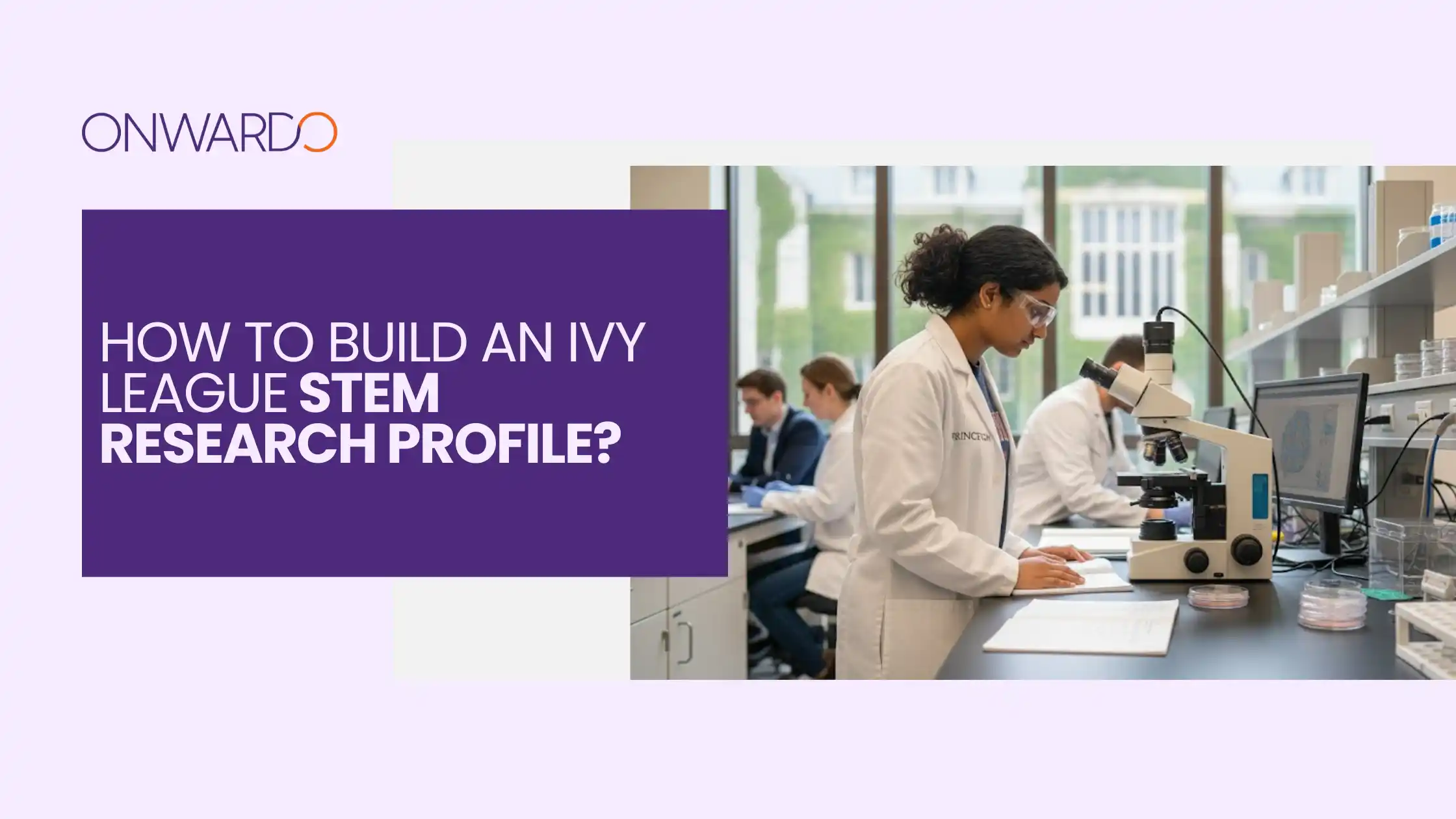
The competition for top science and engineering majors is intense, and a strong Ivy League STEM research profile is now a key requirement for admission. Admissions officers are no longer solely impressed by grades or test scores. They look for curiosity, initiative, and impact in real scientific work.
Over 85% of admitted Ivy STEM students show research involvement. An intentional Ivy League STEM research profile demonstrates that you not only study STEM, but also actively create knowledge, solve problems, and contribute to the field of STEM. Starting early on and building strategically can help transform your application from good to best. Let us learn more!
A compelling Ivy League STEM research profile combines academic rigor with hands-on exploration and visible outcomes. Universities look for history of curiosity, effort, and growth. Some key elements include:
Depth in STEM coursework and academic: By taking the most challenging math and science courses available, which include AP, IB, A-levels, or advanced electives, one demonstrates mastery of intensive university-level STEM.
AP/IB/A-levels: AP Physics C, AP Calculus BC, IB HL Math, HL Physics.
Competitive advanced classes or local advanced STEM programs.
Strong grades in core sciences (Physics, Math, Chemistry, CS).
Participation in research-oriented clubs and competitions: Science fairs, robotics clubs, Math Olympiads, and innovation challenges help you apply theories to reality while building leadership qualities. ( participation in international competitions, global exposure)
Together, all these elements demonstrate that your Ivy League STEM research (Research-Driven Activities & Clubs) profile is grounded in strong academic fundamentals and meaningful real-world applications. Hackathons also play a vital role in showcasing applied problem-solving, collaboration, and innovation—please let me know if we could add relevant hackathon experience to further strengthen this profile.
Starting Early: Building Interest from Grade 9 Onwards( Foundation, Exploration, and consolidation are important factors)
By building a strong Ivy League STEM research profile, start by nurturing the fundamental scientific skills from grade 9:
Lab basics: By following protocols, recording observations, and practicing safe lab habits in school experiments.
Analytical skills: By learning to analyze data, create graphs, interpret results, and also question assumptions through science projects, as well as math problem-solving.
Finding STEM Mentors and Role Models
Mentorship is an important accelerator for any Ivy League STEM research profile. Seek guidance from:
School teachers who oversee different science clubs or other advanced courses.
University professors running outreach or even community research programs.
Industry professionals who include engineering, AI, or data science.
How to Find & Start Research Opportunities in High School
Approaching Faculty for Research Internships
Securing an authentic research experience in lab is most important. To approach the potential mentors:
Research the faculty at nearby universities that align with your interests.
Send concise, respectful emails that share your academic background and explain why their experiences appeal to you.
Offers some assistance with data collection, coding, literature reviews, or with some basic lab tasks.
Leveraging Summer Science Programs & University Workshops
Selecting good summer research programs and workshops is a good stepping stone:Structured programs help you gain expertise and credibility.
University-hosted research academics, which include biology, computer science, or engineering.
Online or hybrid research bootcamps designed for high schoolers.
STEM camps or Olympaid training programs( its not training program you can add Olympiad preparation camps, which culminate in projects or research-style presentations.(Innovation challenges that end with a research-project)
Documenting, Showcasing & Scaling Your Research
Building a Research Portfolio: Papers, Presentations, Awards
By writing short research papers or extended abstracts, you can summarize your results as well as methods.
Presenting at school, local fairs, national science competitions, or for online conferences.
Applying for awards, Olympiads, innovations, or for publishing in student journals.
Effective Science Communication & Digital Presence
Strong communication skills amplify your Ivy League STEM research profile. Consider:
Creation of a simple website or portfolio page summarizing your projects, links, or others.
Sharing code on platforms like GitHub for CS/AI projects.
Writing blog posts or short explainers for your research.
(A personal website and portfolio give the student a strong digital identity. Showcasing coding work, design projects, and game concepts turns their achievements into visible, verifiable proof of ability—something top universities highly value.”
Differentiating your Application: What Ivy League Admissions Seek in STEM Profiles
Unique Problem-Solving, Impact, & Leadership Through Research
Ivy League STEM admission officers do value and prioritize depth, originality, and impact. Strong Ivy League STEM research profile includes:
Tackles meaningful problems, not just textbook requirements.
Demonstrates initiatives- starting projects, leading teams, and so forth.
Shows a measurable impact on the school or the broader community.
Interdisciplinary thinkers stand out. Show depth over breadth.
Building an impactful Ivy League STEM research profile is a long process, not just a last-minute task. Starting in grade 9 allows you to explore interests, find mentors, participate in serious research opportunities, and build a documented portfolio over time. Expert support from partners like Onwardo can strengthen your application for an Ivy League STEM research profile.
Emerging Interdisciplinary Innovator blending Technology, Design, and Problem-Solving with clarity and purpose. Backed by high-value internships and real industry exposure that demonstrates early professional maturity. Delivers portfolio-ready outcomes—apps, websites, design artifacts, and research work that showcase depth, creativity, and execution. Proven leadership through school clubs, tech initiatives, and community impact projects with measurable outcomes. Positions as a fully prepared, globally competitive applicant for top-tier universities, with a compelling narrative and demonstrated excellence
Frequently Asked Questions
When should I start building my Ivy League STEM research profile?
Ideally, from grade 9 or 10, so you have time to explore fields, develop skills, and complete substantial projects.
Do I need published research for admission to an Ivy League STEM program?
Not necessarily, but some form of(externally validated work) validated work—competitions, fairs, or local publications—significantly strengthens an Ivy League STEM research profile.
Can independent projects count as research?
Yes. Well-designed independent projects with clear questions, methods, and results can be awe-inspiring when appropriately documented.
How many research activities do I need to conduct?
Quality over quantity—one or two strong, multi-year research threads are better than many unrelated, shallow activities.
How does Onwardo support STEM-focused students?
Onwardo offers tailored mentoring, project strategy guidance, lab placement support, and application assistance specifically designed to enhance your Ivy League STEM research profile.
How vital are STEM competitions for my research profile?
Participation in and awards from competitions highlight your problem-solving skills and commitment, thereby strengthening your Ivy League STEM research profile.
Can mentorship influence my STEM research opportunities?
Strong mentorship opens doors to quality internships, lab access, and guidance, accelerating the development of your Ivy League STEM research profile.
What role does interdisciplinary research play in Ivy League admissions?
Interdisciplinary projects demonstrate creativity and real-world impact, making your Ivy League STEM research profile unique and more competitive.
Follow us on social media for the latest updates, tips, and success stories.
Fill the details below
Fill the details below
Fill the details below to download
How to Avail Scholarship
It is a simple 3-step process
Step 1
Upload supporting document(s)
Step 2
Receive a waiver code within 1 hr*
Step 3
Apply waiver code while filling the enrolment form
1. We will send you a coupon code for the applicable waiver within 1 working
hr* between 9:30 a.m. and 7:30 p.m.(in case you do not receive any reply, kindly check your
junk and spam folder). Post 7:30 p.m. you will receive the coupon code the next working day.
2. Please apply the waiver code while filling the online enrolment form.
3. Please do not make the payment without applying/availing the coupon code.
If this is not followed, no refund will be provided for the extra fee paid with respect to the
applicable waiver.
4. Waiver policy and Prices are subject to change without prior notice and no
refund will be provided under any circumstances.
5. At any time, you can avail only ONE of the below 5 scholarships.
6. Also, you cannot combine the scholarships with any other offers/ waivers
offered by IMS at the time of enrolment.
7. In case you are eligible for multiple scholarships/offers/waivers at the
same time, the offer that gives you the maximum discount will be considered.
Fill the details below
Your Estimated Score
Note:
Your profile consists of multiple parameters, including academics, aptitude test scores
(GMAT/GRE/SAT), work experience, extracurricular activities (sports, leadership roles), and
statement of purpose
(SOP). Each factor has its own weightage.
Academics is just one of the many factors considered in the overall evaluation.
The above score is an indicative profile score based solely on academic performance and is
not the final score.
The final assessment varies from university to university and program to program.
You can reach out to our expert counselors for a thorough evaluation of your profile.