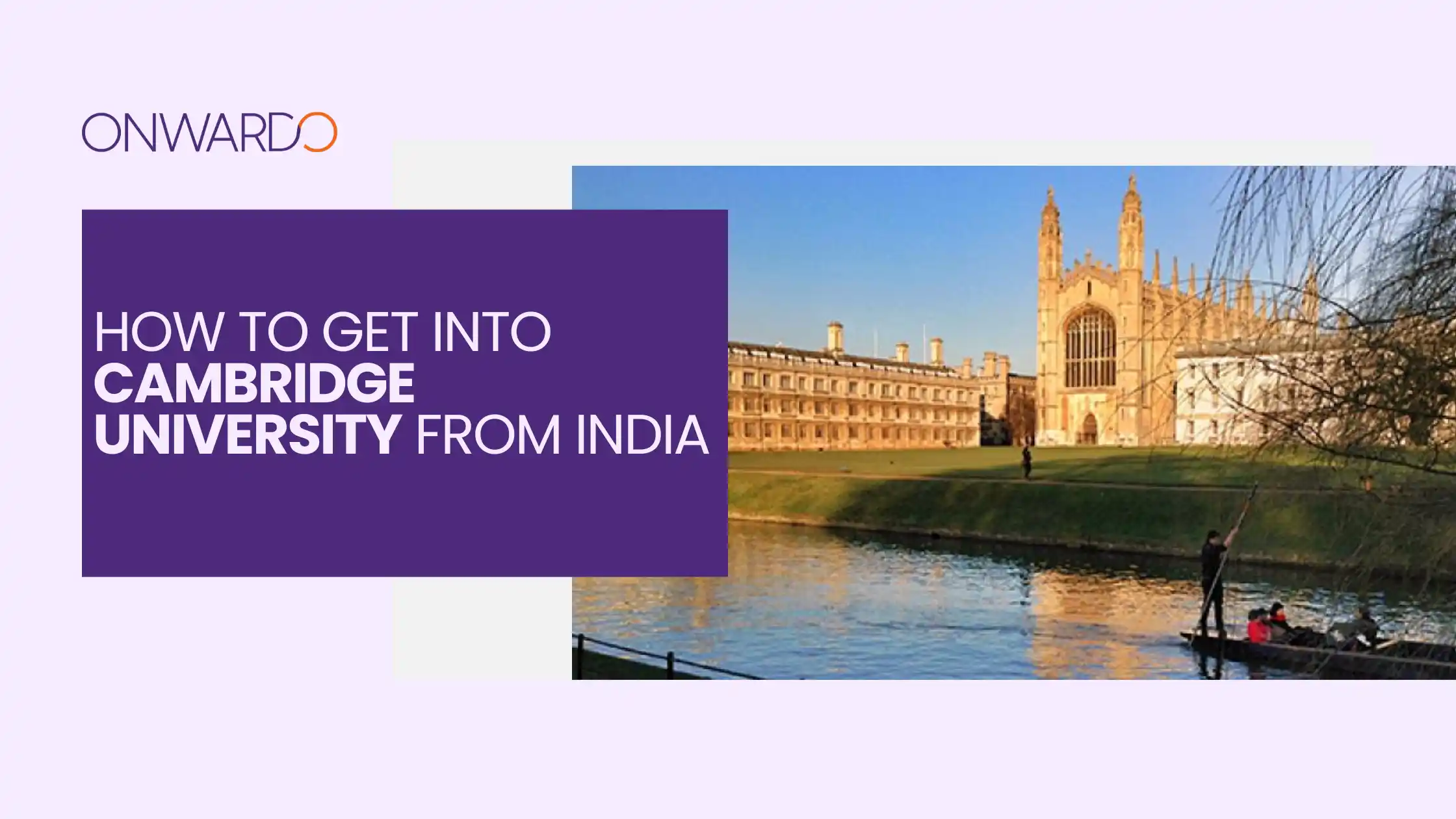
How to Get into Cambridge University From India in 2026
Ananya SaikiaUndergraduateAugust 14, 2026
How to get into Cambridge University from India? Established in 1209, the University of Cambridge is one of the world’s most prestigious academic institutions. It has 31 colleges, six schools, and over 150 faculties and departments located in Cambridgeshire, UK. With students from over 130 countries, Cambridge remains a top priority for international applicants, particularly those seeking postgraduate education. It also ranks sixth globally in QS World Rankings 2026.
For securing admission to Cambridge from India, meeting subject-specific requirements is essential. If you’re exploring how to get into Cambridge University from India, this article will outline the key eligibility criteria for both UG and PG!
🟠 Cambridge University has an overall acceptance rate of 10–15% for 2026/27 — dropping to as low as 5–8% for high-demand courses like Computer Science and Medicine, making it one of the most competitive universities in the world for Indian applicants.
🟠 Indian students applying for undergraduate courses must score 90%+ (CBSE A1 grades) or 95%+ (State Boards) in Class 12 — and must also clear course-specific admission tests such as ESAT (Engineering/Science), TMUA (CS/Economics), or UCAT (Medicine).
🟠 Cambridge’s preferred English proficiency test is IELTS with an overall 7.5 and minimum 7.0 in each section — TOEFL iBT tests taken after January 21, 2026 are no longer considered suitable for entry.
🟠 Undergraduate applications must be submitted via UCAS by October 15, 2026, followed by the mandatory My Cambridge Application by October 22 — missing either deadline disqualifies the application entirely.
🟠 Scholarships including the Dr Manmohan Singh Scholarship and Commonwealth Scholarship offer full coverage of tuition, accommodation, living expenses, and airfare — significantly reducing the total Cambridge cost of £55,000–£75,000 (₹60–81 lakh) for Indian students.
Cambridge University Admission Requirements 2026
For 2026 admissions, Indian students must meet rigorous academic qualifications, standardised test scores and subject-specific requirements set by one of the world’s top universities:
Top Grades: Achieve high grades in the right subjects for your chosen course (A-Levels: A4A or IB Higher Levels).
Course- Specific Requirements: Some courses, such as engineering, may require specific subjects ( e.g: Mathematics).
English Language Proficiency: Non-native English speakers must take an English test (IELTS, TOEFL, PTE).
Other Mandatory Assessments: Certain programs require specialised tests, which include:
ESAT for Engineering and Science-related courses.
TMUA for Computer Science and Economics.
Under 18: Contact the College Admissions Office early to discuss your application.
Under 16: May must fulfill additional requirements (check the course page for details).
Entry Requirements for Undergraduate Courses
One of the essential step in meeting the english language test requirements, as Cambridge expects international applicants to demonstrate strong proficiency through exams like IELTS, TOEFL or equivalent.
English Language Test Requirements for Cambridge University
IELTS: Overall score of 7.5, with at least 7.0 in each section.
TOEFL iBT: Cambridge has officially stated that TOEFL iBT tests taken after January 21, 2026, may not be suitable for entry. They prefer you take the IELTS (7.5) or a C2 Proficiency test instead
Cambridge English: A C2 Proficiency or C1 Advanced certificate is also accepted.
Gaining admission to the University of Cambridge, one of the top 10 most competitive universities globally, is challenging, especially for undergraduate courses. Indian students aiming for admission must realize that a Class 12 school leaving certificate alone won’t make their application stand out. The university requires additional exams to strengthen their application.
Here is a list additional qualifications accepted by Cambridge University for Indian students:
Qualification
Details
College Board Advanced Placement (AP) Tests
Conditional offers for most courses (except Mathematics) may be extended with grades of 5 in five or more AP tests.
IIT-JEE (Advanced)
Conditional offers for Engineering, Chemical Engineering, and Natural Sciences (Physical) courses with a rank under 2000 in the IIT JEE exam may be extended.
STEP (Sixth Term Examination Paper)
Conditional offers for Mathematics and related subjects (Computer Science, Engineering, Economics) if A-level Mathematics or Further Mathematics is not demonstrated by other exams.
Additionally, Indian students must achieve high scores in their class 12 exams. The expected grades would depend on the educational board:
School Board
Expected Marks/Scores
CISCE and NIOS
90% or higher in 5 or more relevant subjects
CBSE
A1 grades in 5 or more relevant subjects
State Boards
95% or higher in 5 or more relevant subjects (considered on a case-by-case basis)
Entry Requirements for Postgraduate Courses
Applicants must typically hold a 2:1 (upper second class) bachelor’s degree or equivalent when applying for postgraduate courses at the University of Cambridge. However, certain courses may require a first-class degree, so checking the specific requirements for your chosen program is essential. Below are the essential requirements:
Requirement
Details
Bachelor’s Degree
75%+ marks in a 3/4/5-year bachelor’s degree in a relevant subject/field.
Institution Recognition
The degree must be obtained from an Ecctis-recognized institution.
First-Class Degree
For first-class honors degrees, the minimum required marks are 75%.
How to Apply to the University of Cambridge from India for Undergraduate Courses
To apply for an undergraduate course at the University of Cambridge, you must submit your application via the UCAS portal. The portal for the next cycle (2027 Entry) opens May 2026; The deadline is Oct 15, 2026. There are different ways to submit your application, either by specifying your preferred college or by submitting an open application, Here is what is required:
Register and Prepare for Assessments: Prepare for any required assessments specific to your chosen course.
Submit UCAS Application: Complete and submit the UCAS application form on time. Be sure to include a strong personal statement. You must provide the institution code (CAM C05) and college code. If submitting an open application, enter “9” in the college code section.
Complete My Cambridge Application: Fill out and submit your My Cambridge Application. This is due by 22nd October, exactly seven days after the UCAS deadline
Fill Out the Extenuating Circumstances Form (ECF): If your studies have been disrupted, use this form to provide additional context for your application.
Prepare for Assessment: Take any required assessments after submitting your UCAS and My Cambridge applications.
How to Apply to the University of Cambridge from India for Postgraduate Courses
Before applying for a postgraduate course at the University of Cambridge, check your chosen course’s eligibility, application requirements, deadlines, and fees. Here are the steps to apply:
Step
Details
Visit the Course Page
Go to your desired course page and click on “Apply.” This will redirect you to the application portal.
Register on the Portal
Create an account, upload the required documents, and submit your application before the deadline.
Application Completion
Your application is considered complete when:
– All required documents are attached.
– The application fee is paid, or you’re granted an application fee waiver. If applying for funding, indicate it in your application.
– Your referees have submitted references through the university’s Referee Portal.
Tips to Get into Cambridge University
Tip
Details
Tip 1: Maintain a Good Academic Record
Cambridge is known for its rigorous academic programs. Ensure your academic record is exceptional, as demonstrated by your transcripts and certificates.
Tip 2: Prepare Documents Well in Advance
Carefully plan and prepare your application documents, including references and personal statements. Make sure you have time to review and revise them before submission.
Tip 3: Maintain a Holistic Profile
Cambridge evaluates more than just your academics. To strengthen your profile, show your involvement in extracurricular activities, volunteer work, and soft skills.
Challenges of Getting into Cambridge
Here are some challenges Indian students may face the following:
High Competition: The large volume of applications makes it highly competitive for Indian students.
Limited Research Opportunities: Indian Institutions may offer fewer research options than international counterparts, putting students at a disadvantage.
Personal Statement Challenges: Non-native English speakers may struggle to create concise, compelling personal statements.
Reference Letter Issues: Securing strong reference letters from academics unfamiliar with international research standards can be complex.
Financial Strain: High tuition fees, living costs, and travel expenses can be very burdensome, and obtaining financial aid or scholarships may be very challenging.
Scholarships to Study at Cambridge
Scholarship
Eligibility
Benefit
Charles Wallace India Trust Scholarships
Indian citizens aged 28-38 pursuing a postgraduate course in art or heritage
Covers accommodation and living costs in the UK + £700 (INR 73,114) for international travel.
Commonwealth Scholarship and Fellowship Plan
Permanent residents of Commonwealth countries with an undergraduate honors degree (2:1) and financial need
Full coverage of expenses with a monthly stipend of £1,652 (Rs 2,02,145).
Dr Manmohan Singh Scholarship
Indian students pursuing a doctorate at St. John’s College, University of Cambridge
Full coverage of tuition fees, accommodation, living expenses, airfare, and a monthly stipend.
Frequently Asked Questions
How can an Indian student get into Cambridge?
To get into Cambridge as an Indian student, you should get exceptional Class 12 grades (90-95%+) and do well in course-specific admission tests like ESAT (STEM), TMUA (Economics/CS) or UCAT (Medicine). After submitting your applications by October 15, you should complete a secondary “My Cambridge Application” and clear an academic interview focused on your subject-specific problem-solving skills.
How much does Cambridge cost for Indian students?
For Indian students, going to Cambridge costs between £55,000 and £75,000 (approx. ₹60–81 Lakh). It covers tuition, college fees and living expenses. The total cost may vary according to the course. Humanities cost much lesser than Medicine and STEM courses at Cambridge.
Can I go to Cambridge after 12th?
Yes, you can go to Cambridge after 12th. Most Indian students submit their application by October 15 while still in Class 12 to get admission in the autumn of the following year. But you should score 90-95+% in your 12th with mandatory exams like ESAT, TMUA or UCAT.
What qualifications do I need to get into Cambridge University?
To get into Cambridge University, you need a 90-95+% score in Class 12 (CBSE/ISC/State Boards) and must pass ESAT, TMUA or UCAT. In addition to this, students can also use their AP scores or an IIT-JEE ranks to meet the university’s rigorous requirements.
Is Cambridge University hard to get into?
Cambridge University admissions are very competitive with an acceptance rate of 10-15% for the 2026/2-27 cycle. For courses that are high in demand such as Computer Science or Medicine, the success rate for Indian students can be as low as 5-8%, making it one of the toughest universities to get into.
Follow us on social media for the latest updates, tips, and success stories.
Fill the details below
Fill the details below
Fill the details below to download
How to Avail Scholarship
It is a simple 3-step process
Step 1
Upload supporting document(s)
Step 2
Receive a waiver code within 1 hr*
Step 3
Apply waiver code while filling the enrolment form
1. We will send you a coupon code for the applicable waiver within 1 working
hr* between 9:30 a.m. and 7:30 p.m.(in case you do not receive any reply, kindly check your
junk and spam folder). Post 7:30 p.m. you will receive the coupon code the next working day.
2. Please apply the waiver code while filling the online enrolment form.
3. Please do not make the payment without applying/availing the coupon code.
If this is not followed, no refund will be provided for the extra fee paid with respect to the
applicable waiver.
4. Waiver policy and Prices are subject to change without prior notice and no
refund will be provided under any circumstances.
5. At any time, you can avail only ONE of the below 5 scholarships.
6. Also, you cannot combine the scholarships with any other offers/ waivers
offered by IMS at the time of enrolment.
7. In case you are eligible for multiple scholarships/offers/waivers at the
same time, the offer that gives you the maximum discount will be considered.
Fill the details below
Your Estimated Score
Note:
Your profile consists of multiple parameters, including academics, aptitude test scores
(GMAT/GRE/SAT), work experience, extracurricular activities (sports, leadership roles), and
statement of purpose
(SOP). Each factor has its own weightage.
Academics is just one of the many factors considered in the overall evaluation.
The above score is an indicative profile score based solely on academic performance and is
not the final score.
The final assessment varies from university to university and program to program.
You can reach out to our expert counselors for a thorough evaluation of your profile.